
Translated from Turkish by Beyza Çavdar
Original Text: Bakunin’in Barikatı Kime Hizmet Ediyor? (Arsperas, 2025)
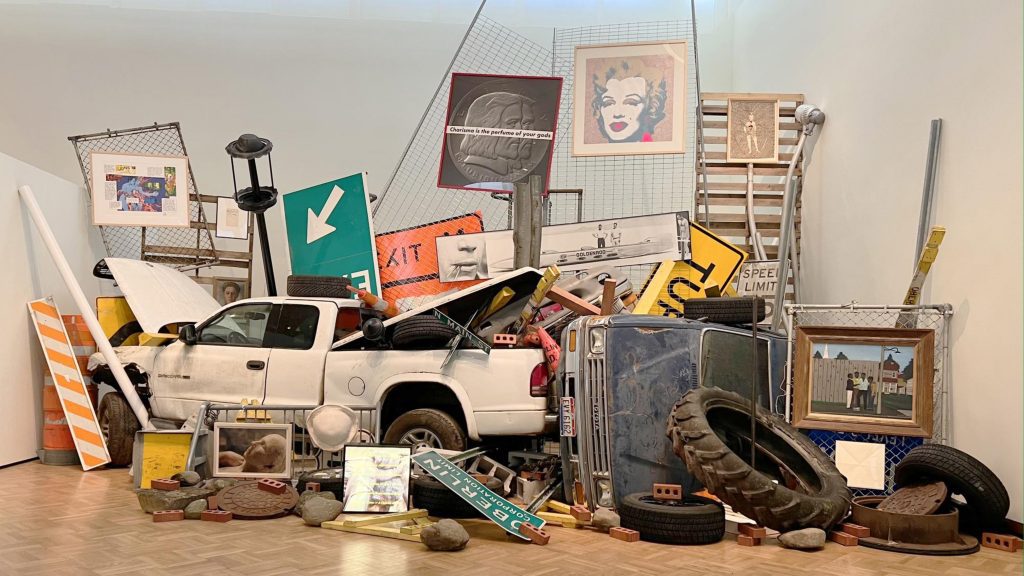
The starting point of the work of the artist Ahmet Öğüt’s Bakunin’s Barricade, which is in the permanent collection of the Stedelijk Museum Amsterdam, is based on a radical idea called “barricade” proposed by Mihail Bakunin during the Dresden Uprising- an idea that was never realized. Bakunin believed that if, in the barricade, the most valuable works of art belonging to bourgeois culture were included, then the state soldiers couldn’t dare to target any of them. As the very guardians of the system in question, they wouldn’t even contemplate engaging in any act that might harm the bourgeoise. So, Bakunin suggested employing the symbolic and economic value of artworks as the shield for revolutionary resistance.
The Bakunin’s Barricade, which was first exhibited in the Van Abbemuseum in Eindhoven in 2015, reached today’s design with the incorporation of the other works in the collection of the museum such as Pablo Picasso, El Lissitzky, Oskar Kokoschka, Fernand Léger, Asger Jorn, Ger van Elk, René Daniëls ve Marlene Dumas and was presented as a conceptual gesture transforming the collection into a tool of resistance. In time, the work was recreated by various institutions and its different versions were also produced. And by purchasing one of these versions, Stedelijk Museum incorporated it into its own permanent collection.
The work was brought into question again during a protest in Amsterdam organized against the genocide in Palestine. The protesters asked Stedelijk Museum to lend them the Barricade so they could use it throughout their actions. Öğüt also intervened in the process, stating that according to the sales agreement, the Barricade must be handed over to groups if the intended use is functional. He even explicitly told the museum, “You have to”. And it is no surprise that the museum replied to this demand by saying: “It is not possible for us to give the original version of the artwork but we can readily provide the copy. This was the exact moment when the conceptual spell was broken. For the instant the political artwork became relatable to an actual political need, its claim to radicalism shattered. The controversy emerged from this paradoxical exchange a year ago and it has been rekindled following last week’s reel posted by journalist Elif Bereketli.
It was problematic from the very beginning that the Öğüt´s attempt to sell the revolutionary anarchist Bakunnin´s idea to the museum. Just another problem of the post-conceptual art world. An industry in which the idea on its own becomes commoditized, where supposedly ‘smartest’ most impress academicians, curators, and cultural elite win, and where the circulation, reception and its marketabikty of the concept even become more important than anything else. The idea belongs to the one who best presents/packages it, however it achieves legitimacy as much as it receives considerable value within the institutional circulation. Bakunnin´s Barricade mirrors this dynamic. It was from the very beginning a kind of betrayal to the idea itself to adopt the proposal of using bourgeois cultural capital to the detriment of the bourgeoise and even put this object in a museum which is one of the most sanitized spaces of state-capital articulation. So, even before the dispute regarding Palestine ,placing this radical work of art behind the walls of a museum was already a conceptual paradox- one that tames a revolutionary image within institutional security and sustains its radicalism only at a highly controlled level of representation. This evokes Bakunnin’s ghost and confines him to the museum shelf. Bakunin’s anti-elitist ghost was transformed into a safe decorative object with which the elite can polish their own progressive images.
What later happened during the Palestine protest turned out to be a genuine litmus test. Nevertheless, it uncovers not the hypocrisy of the museum but a completely different story. The barricade was not carried out for the street and it was not for taking risk in the street but to create a risk image in the museum at hand. Following the denial of the museum with regard to the lending the original, the genuine function of the work has become clearer. The barricade wouldn’t protect society but the museum itself. The idea generated by Bakunin to bring about a panic for bourgeoisie, got to be transformed into a magical object to the interest of the bourgeoisie in the hands of Öğüt.
In the process, the artist also took the position which made the structural inconsistencies of the conventional art more apparent. He, by selling his work to the museum, not only accepts to submit it to institutional property and then also presents museums denial as a political crisis. So, a sense of astonishment at the act that integrates a radical image to the institution and foreseeable reflexes of the institutional economy was being produced simultaneously. At that point, it has become even more evident how the gesture economy of the field of conceptual art can locate the artist in the position of both producer and consumer, and seller and victim at the same time. The image of rebellion enters circulation as a commodity; a political economy is established in which the commodity preceded the revolt and representation precedes praxis. As a result, though all the advantages of being seen as radical are taken, that costs of becoming radical are not paid at all.
The new life of the barricade that Barricade found within the museum also conveys a harsher ideological command: “the place of art is in museums, if more suitable place is available it is in the houses of wealthy collectors. This perspective imply that the barricade has no place in the street, inasmuch as streets opens up the possibility for a real political risk, class- based threat and an actual bodily rupture. The system- one in which the interests of bourgeoisie are prioritized, seeks to precisely eliminate this possibility. For this reason delivering the barricade to the street is by no means structurally possible. Only if the barricade is turned into a form over which bourgeois can exercise control, does it become acceptable.
This fact also hints at the reality that even a barricade created to symbolize a radical idea was, in fact, produced to be seen, interpreted and understood behind the walls of the museum. Museum visitors encounter not the barricade itself, but its representation- and the institutional interpretative framework that governs this representation. The museum doesn’t offer the actual street experience but rather an aestheticized, disciplined and carefully directed barricade experience. And this kind of experience has nothing to do with the historical meaning of the barricade: collective resistance, chaos, rupture, and the bodily risk of harm. By relocating the meaning of the barricade into the museum, which, by definition, must be born in the street, the institution neutralizes it.
This is simultaneously a tremendously ideological positioning in terms of class, for the individuals who possess possibility of establishing a real barricade in streets are those who cannot enter the museum; even if they do, they appear there as spectators not as subjects. The fact that the artwork is trapped inside the museum actually hand over the barricade’s right of representation over to a higher aesthetic framework on behalf of the people. Any potential barricade experience becomes confined to an image which is purged of real bodily harm and political subjectivation and packaged by the institution.
In short, this issue gains a pedagogical function: it educates the radical possibility through the museum, and place it within an institutional discipline. This is clearly visible in the prioritization of the museum over the street, representation over action, aesthetic governance over risk. And the outcome leaves no room for interpretation: Öğüt’s Barricade protects bourgeoise. If Bakunin were still alive, he would break it into pieces without a second thought. It can be assumed that even then, the artist wouldn’t hesitate to package the Bakunin’s act of breaking and sell it to another museum.
Cover: Bakunin’s Barricade, Oberlin, Ohio, USA (2022).
Including works from the Allen Memorial Art Museum.